
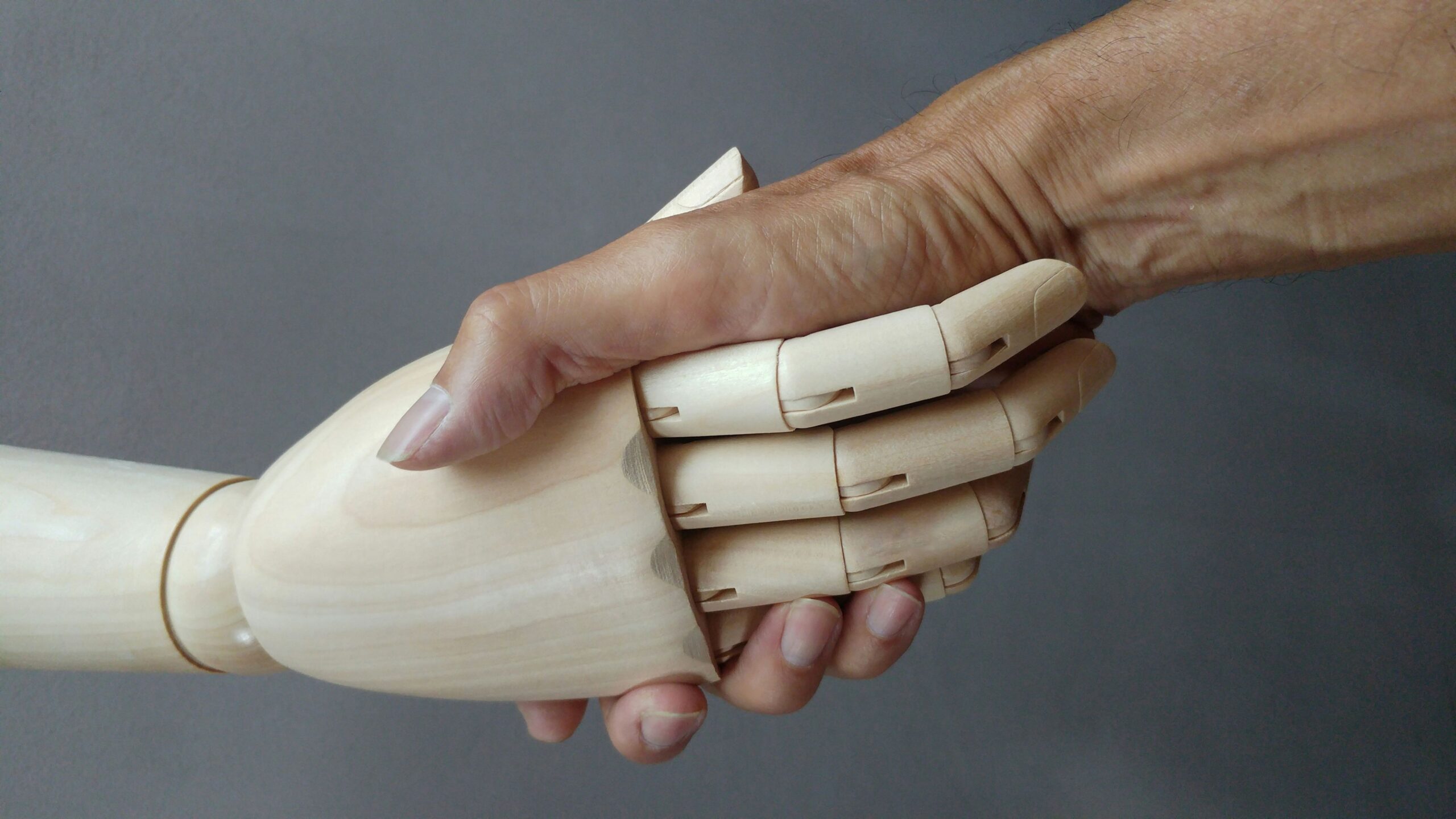
As AI becomes embedded in everyday work, turning to it for support is becoming increasingly common. That support may mean generating a “thank you” email when we struggle to find the words, or asking AI to weigh the trade-offs in a complex, high-stakes decision. AI can lend a helping hand, and evidence suggests that this help can translate into greater productivity and stronger task performance. When the helping hand is so readily available, it can be tempting to reach for whenever we encounter a problem.
But what does this mean for how we reason and make decisions? Is it possible that the technologies designed to help us think are also beginning to think for us?
Emerging research is examining how generative AI tools may impact how we think. As the evidence continues to take shape, this raises an immediate leadership question: how can leaders harness the potential of AI while preserving the human judgement needed to think critically, navigate complexity and make consequential decisions?
Rethinking Human Reasoning in the Age of AI
Dual Process Theory, popularised by psychologist Daniel Kahneman, offers a useful starting point for understanding how we reason. It distinguishes between two modes of thinking: System 1 is fast, intuitive and automatic, while System 2 is slower, more deliberate and analytical. System 1 allows us to handle familiar or routine activity with little conscious effort. System 2 demands greater attention, becoming particularly important when we need to interpret evidence, test assumptions, resolve competing priorities or question our initial response.
Yet, what happens when thinking takes place outside the human mind?
Earlier this year, researchers Steven Shaw and Gideon Nave proposed the Tri-System Theory, introducing a third element into the picture: System 3, where cognitive work is performed externally by an artificial system. Their proposal asks us to consider how artificial thinking changes the relationship between our own intuitive and analytical modes of thinking.
One possibility, which Shaw and Nave term cognitive surrender, is uncritically adopting AI’s answers instead of one’s own reasoning. Rather than supporting a person’s thinking, AI can become a substitute for engaging in the reasoning process itself. In practice, this might look like asking AI to interpret an analysis and accepting its conclusions without checking the assumptions, evidence or alternative interpretations behind them.
How does Cognitive Surrender Take Hold?
Shaw and Nave explored what happens to people’s reasoning when AI advice is available. Across more than 1,300 participants and nearly 10,000 trials, participants answered reasoning and knowledge questions, with some able to consult a chatbot that provided either correct or incorrect answers.
The findings reveal a potential “double edge” of AI-supported reasoning. When participants consulted the AI and received the correct answer, their accuracy was 25 percentage points higher than that of participants without AI. But when the AI was wrong, their accuracy was 15 percentage points lower. In other words, AI could improve reasoning performance when it was right, but leave people worse off when they deferred to it and it was wrong.
The effects extended beyond accuracy. Consulting AI also increased how confident people felt even when the chatbot was wrong. The researchers suggest that reliance on external reasoning may bypass some of the cues that would ordinarily prompt people to scrutinise an answer more carefully.
Yet people were not equally susceptible. Greater trust in AI was associated with a higher likelihood of following incorrect advice, while stronger reasoning ability and a greater inclination towards analytical thinking appeared to offer some protection. This suggests that cognitive surrender may depend not only on what AI produces, but also on how people approach and evaluate it.
The confidence of the AI itself may add another layer to this problem. Separate research comparing humans and large language models found that the models did not reliably recalibrate their confidence after performing poorly. Incorrect AI output may therefore still be presented with apparent confidence, offering users fewer cues that further scrutiny is warranted.
These findings point to a potential risk as opposed to an established account of workplace behaviour. The studies described here involve bounded tasks, and more research is needed to tease out how these patterns play out in organisational settings, where expertise, relationships, competing priorities and accountability may also shape judgement. As AI becomes part of how we reason at work, the question is therefore not simply whether we use it, but how we remain active judges of its output rather than passive recipients of it.
Preserving Judgement in the Context of AI
The emerging evidence does not yet tell us exactly how cognitive surrender plays out across organisations. Yet it does give leaders reason to consider where human judgement matters most, and how working practices can support it.
Not every use of AI requires the same degree of scrutiny. Using AI to support routine, low-risk tasks is different from relying on it to interpret ambiguous evidence or inform a decision with significant consequences. This distinction may be particularly important in certain work domains, such as health care, education and law, that depend more heavily on human judgement and accountability.
Assessing AI output and deciding when and where to use it requires careful judgement from the user, but leadership also shapes the conditions in which that thinking takes place. Processes, structures and systems can be designed to encourage people to question outputs, test assumptions and surface blindspots, rather than simply accept plausible answers. Leaders can consider how incentives for accuracy, learning, and critical thinking are built into AI-enabled work, so that AI augments rather than replaces human reasoning. This might mean designing workflows and interfaces that prompt greater scrutiny, or analysing tasks across roles to distinguish what can be offloaded from the work that calls for human judgement.
Staying Alert as AI Evolves
AI capabilities and interfaces are rapidly changing. As tools become more agentic, organisations will need to revisit not only how decisions are supported by AI, but also which decisions are being delegated to it in the first place. The boundaries between useful cognitive support and cognitive surrender may shift as the technology evolves. The challenge, therefore, is not static. Staying alert to these changing boundaries may become an important part of leading in the age of AI.
One enduring leadership challenge will be ensuring that greater technological capability does not come at the expense of human judgement. The opportunity is to develop a relationship in which AI complements human strengths and expands what people are able to consider, while people remain actively engaged in interpreting, questioning and deciding. This may make critical thinking and judgement increasingly central to how leaders navigate the complexity and ambiguity that accompany AI in organisational life.
Research into these questions will continue to evolve; however, leaders do not need perfect evidence to begin paying attention to where thinking and decision-making are shifting, and what those shifts mean for teams and organisations. As AI assumes a greater role in how work is done, the important question may be less whether we use it, and more how we ensure that people remain active participants in the thinking that matters.
When does AI help you think better, and when does it begin to do too much of the thinking for you? As a leader, what might help people recognise the difference?
We would welcome your reflections.
References
Abrams, Z. (2026, July 1). How AI is reshaping human skills and thinking. American Psychological Association. https://www.apa.org/monitor/2026/07-08/ai-job-skills-thinking
Baskin, K. (2026, October 5). The collision: What AI does to us. MIT Sloan School of Management. https://mitsloan.mit.edu/ideas-made-to-matter/collision-what-ai-does-to-us
Bittel, J. (2025, July 30). AI chatbots remain confident—even when they’re wrong. Carnegie Mellon University. https://www.cmu.edu/news/stories/archives/2025/july/ai-chatbots-remain-confident-even-when-theyre-wrong
Cash, T. N., & Oppenheimer, D. M. (2024). Generative chatbots ain’t experts: Exploring cognitive and metacognitive limitations that hinder expertise in generative chatbots. Journal of Applied Research in Memory and Cognition, 13(4), 490–494. https://doi.org/10.1037/mac0000202
Durth, S., Goran, J., & Hancock, B. (2026, April 6). How AI is—and isn’t—changing the future of work. McKinsey & Company. https://www.mckinsey.com/capabilities/people-and-organization/our-insights/the-organization-blog/how-ai-is-and-isnt-changing-the-future-of-work
French, A. M., & Shim, J. P. (2025). From artificial intelligence to augmented intelligence: A shift in perspective, application, and conceptualization of AI. Information Systems Frontiers, 27, 1345–1366. https://doi.org/10.1007/s10796-024-10562-2
Helal, M. Y. I., Elgendy, I. A., Albashrawi, M. A., Dwivedi, Y. K., Al-Ahmadi, M. S., & Jeon, I. (2026). The impact of generative AI on critical thinking skills: A systematic review, conceptual framework and future research directions. Information Discovery and Delivery, 54(4), 690–704. https://doi.org/10.1108/IDD-05-2025-0125
Kahneman, D. (2011). Thinking, fast and slow. Farrar, Straus and Giroux. https://psycnet.apa.org/record/2011-26535-000
Likierman, A., Pisa, K., & Mansoor, M. (2025, November 28). Why human judgement is essential in the age of AI. London Business School. https://www.london.edu/think/human-judgement-essential-in-ai
Noy, S., & Zhang, W. (2023). Experimental evidence on the productivity effects of generative artificial intelligence. Science, 381, 187–192. https://www.science.org/doi/10.1126/science.adh2586
Pearson, H. (2026, September 23). How to stay smart in the age of AI: The science of critical thinking. Nature. https://www.nature.com/articles/d41586-026-02930-6?error=cookies_not_supported&code=20337eb3-022b-470f-8213-77d22190d129
Shaw, S. D., & Nave, G. (2026, January 11). Thinking—fast, slow, and artificial: How AI is reshaping human reasoning and the rise of cognitive surrender. SSRN. https://doi.org/10.31234/osf.io/yk25n_v
Wharton Executive Education. (2026, May). Thinking fast, slow, artificially: AI and your brain. https://executiveeducation.wharton.upenn.edu/thought-leadership/wharton-at-work/2026/05/thinking-fast-slow-and-artificially/
Wu, S., Liu, Y., Ruan, M., et al. (2025). Human-generative AI collaboration enhances task performance but undermines human’s intrinsic motivation. Scientific Reports, 15, 15105. https://www.nature.com/articles/s41598-025-98385-2